
 Post by
Plastic plays an important role in modern manufacturing. From packaging and automotive components to construction materials, medical products, electronics, and consumer goods, plastics are used across almost every major industry. As demand continues to grow, manufacturers are under increasing pressure to improve production efficiency while reducing material waste and environmental impact.
This is where plastic processing and recycling become increasingly important. Modern technologies allow businesses to transform polymers into useful products, recover valuable materials from plastic waste, and improve the overall efficiency of manufacturing operations.
For businesses planning a new production line, upgrading existing equipment, or introducing recycling capabilities, understanding the available technologies is an important first step.
What Is Plastic Processing?
Plastic processing refers to the different industrial methods used to transform plastic raw materials into finished or semi-finished products. Depending on the type of polymer, product requirements, production volume, and desired characteristics, manufacturers can choose from several processing techniques.
Common plastic processing methods include:
- Injection molding
- Extrusion
- Blow molding
- Thermoforming
- Rotational molding
- Compounding
- Compression molding
Each method has a specific purpose and works with different materials and product designs. For example, injection molding is commonly used for producing precise components in large quantities, while extrusion is suitable for continuous products such as pipes, sheets, films, and profiles.
Choosing the right processing technology is therefore not simply about selecting machinery. Businesses need to consider material characteristics, product specifications, production capacity, energy consumption, automation requirements, and operating costs.
Why Is Plastic Processing Important?
Efficient processing directly affects the quality, consistency, and profitability of manufacturing operations.
A well-designed processing system can help businesses:
- Maintain consistent product quality
- Increase production capacity
- Reduce material waste
- Improve energy efficiency
- Minimize production downtime
- Improve workplace safety
- Reduce operating costs
- Support automation
- Achieve more consistent production results
The right technology also allows manufacturers to respond more effectively to changing market requirements. As customers increasingly demand lightweight, durable, recyclable, and customized products, flexible processing systems can provide a significant operational advantage.
Major Plastic Processing Technologies
1. Injection Molding
Injection molding is one of the most widely used plastic manufacturing processes. Plastic pellets are heated until they become molten and are then injected into a mold under controlled pressure.
Once the material cools and solidifies, the finished component is removed from the mold.
This process is particularly useful for producing large quantities of identical components. It is widely used in automotive parts, electrical components, packaging, household products, medical equipment, and consumer goods.
The major advantages include high repeatability, fast production cycles, and the ability to manufacture complex shapes.
However, selecting suitable machinery, molds, materials, and process parameters is essential for achieving consistent results.
2. Plastic Extrusion
Extrusion is designed for producing continuous plastic products. During the process, plastic material is heated and pushed through a specially designed die to create a continuous profile.
Common extrusion products include:
- Pipes
- Tubes
- Sheets
- Films
- Cables
- Profiles
- Plastic strips
Extrusion systems can be customized according to the material and product specifications. Process control is particularly important because temperature, pressure, screw configuration, and cooling conditions can influence the final product.
3. Blow Molding
Blow molding is primarily used for manufacturing hollow plastic products. The process involves forming a heated plastic tube or preform and expanding it inside a mold using air pressure.
This technology is commonly used for:
- Bottles
- Containers
- Tanks
- Packaging products
- Industrial hollow components
It offers an efficient way to produce lightweight hollow products at scale.
4. Thermoforming
Thermoforming involves heating a plastic sheet until it becomes flexible and then forming it over or into a mold.
After cooling, the shaped product is trimmed to its final dimensions.
The process is frequently used for packaging, trays, disposable products, automotive components, and various industrial applications.
Thermoforming can be attractive for businesses that require relatively lightweight products and flexible production capabilities.
5. Rotational Molding
Rotational molding is suitable for manufacturing large, hollow plastic products. Plastic material is placed inside a mold, which is then heated and rotated along multiple axes.
The material gradually coats the inside of the mold before cooling into the desired shape.
Products made using this process can include storage tanks, containers, industrial components, and recreational products.
Understanding Plastic Recycling
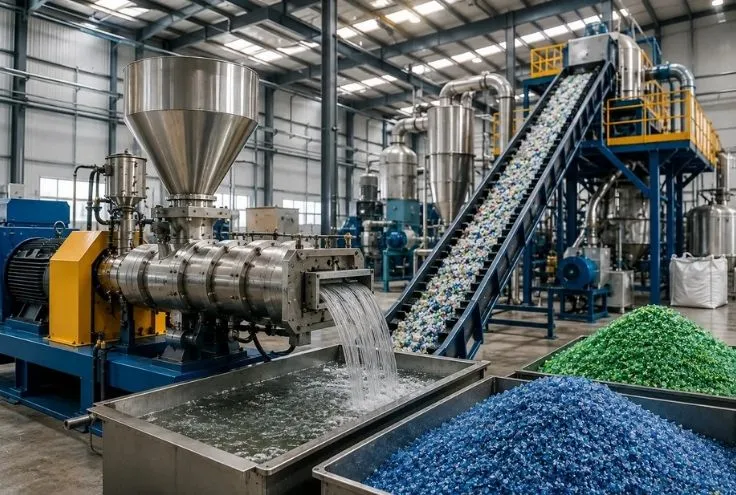
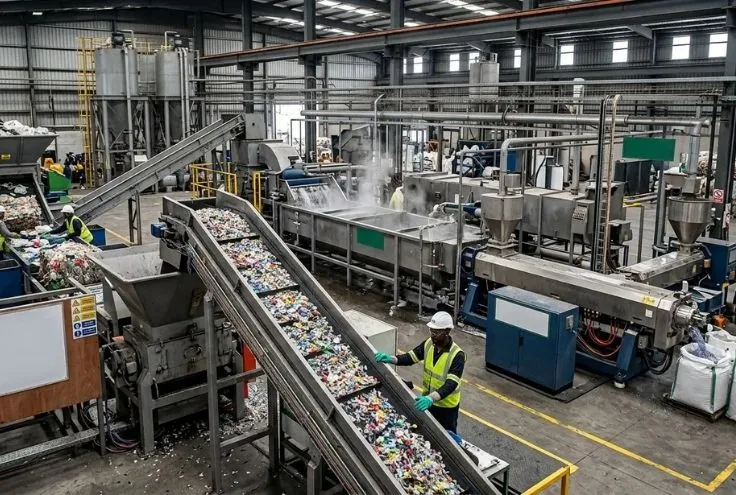
While processing focuses on converting raw materials into products, recycling focuses on recovering usable material from plastic waste. Plastic recycling typically involves several stages, including collection, sorting, cleaning, size reduction, processing, and pelletizing or conversion into a reusable material.
The exact process depends on the type and condition of the plastic waste. An effective recycling operation needs more than a recycling machine. Material quality, contamination levels, sorting accuracy, processing conditions, and output requirements all influence the performance of the system.
How Does Plastic Recycling Work?
A typical recycling process may include the following stages.
Collection and Preparation
Plastic waste is collected from manufacturing operations, commercial sources, post-consumer applications, or other industrial streams. The material is then prepared for processing.
Sorting
Different plastics have different physical and chemical characteristics. Sorting helps separate materials according to polymer type, color, size, or other characteristics. Modern sorting systems can use mechanical and automated technologies to improve material separation.
Shredding and Size Reduction
Once sorted, plastic waste is reduced into smaller pieces using shredders or granulators. Reducing material size makes subsequent washing, separation, and processing more manageable.
Washing and Cleaning
Plastic waste may contain dust, labels, oils, food residues, adhesives, or other contaminants. Washing systems remove unwanted materials and help improve the quality of recycled output. The cleaning requirements depend heavily on the source and intended application of the recycled material.
Drying
After washing, moisture must be removed before further processing. Efficient drying is particularly important because excessive moisture can affect processing performance and the quality of recycled material.
Extrusion and Pelletizing
Clean plastic material can be melted and processed through an extrusion system. The resulting material can then be converted into pellets. These recycled pellets can potentially be used as a raw material in future manufacturing processes, depending on their quality and application.
Different Types of Plastic Recycling
Not all recycling approaches are the same. The appropriate method depends on the material, waste stream, contamination, and desired output.
Mechanical Recycling
Mechanical recycling physically processes plastic waste without fundamentally changing its chemical structure. Typical stages include sorting, shredding, washing, drying, melting, extrusion, and pelletizing. It is widely used because it can recover material while maintaining the polymer’s basic structure.
Chemical Recycling
Chemical recycling uses processes that break polymers down into chemical components that can potentially be used to create new materials. This approach can be considered for certain waste streams that are difficult to manage through conventional mechanical recycling. However, the appropriate technology depends on the specific polymer, feedstock quality, economics, and intended application.
How to Choose the Right Plastic Processing or Recycling Technology
Selecting equipment should begin with the application, not the machine. Before making a technology decision, businesses should evaluate several factors.
1. Material Type
Different polymers behave differently during processing. The material being handled should therefore be clearly identified before selecting equipment.
2. Production Capacity
A small production operation has different requirements from a high-volume industrial facility. Equipment capacity should match current production requirements while leaving reasonable room for future expansion.
3. Product Specifications
Dimensions, shape, strength, surface finish, tolerances, and other product requirements can determine which processing method is appropriate.
4. Feedstock Quality
For recycling projects, the condition of incoming material is particularly important. Highly contaminated or mixed waste may require more extensive sorting and cleaning systems.
5. Energy Efficiency
Energy consumption can significantly affect long-term operating costs. Modern equipment with efficient heating, drives, automation, and process control can help businesses manage energy use more effectively.
6. Automation Requirements
Automation can improve consistency, productivity, monitoring, and operational control. However, automation should be selected based on actual production requirements rather than added simply for the sake of technology.
7. Maintenance and Technical Support
Even high-quality equipment requires regular maintenance and technical assistance.
Businesses should consider spare parts availability, service response, operator training, and long-term technical support when evaluating technology partners.
Plastic Processing and Recycling: Why Integration Matters
For many industrial projects, processing and recycling should not be viewed as completely separate activities. Manufacturing operations generate scrap, offcuts, rejected products, and other plastic waste. When suitable materials can be recovered and reintroduced into production, businesses may reduce material losses and improve resource efficiency.
An integrated approach can include:
Production → Waste Collection → Sorting → Recycling → Reprocessing → Production
The exact system depends on the material and application, but this approach can help create a more efficient material cycle.
Applications Across Industries
Packaging
Plastic processing is widely used to manufacture bottles, containers, films, caps, trays, and other packaging products. Recycling systems can help recover suitable packaging materials and convert them into reusable feedstock.
Automotive
Automotive manufacturers use plastics for interior components, exterior parts, technical components, and lightweight structures. Processing technologies must deliver accuracy, durability, and consistency.
Conclusion
Plastic processing and recycling are becoming increasingly important for businesses looking to improve manufacturing efficiency, reduce waste, and make better use of raw materials. From injection molding and extrusion to sorting, washing, and pelletizing, each technology serves a specific purpose and should be selected based on material type, production requirements, product specifications, and operational goals. Understanding these technologies helps businesses make informed decisions when upgrading existing operations or developing new capabilities.
A successful plastic processing or recycling project requires more than advanced machinery. Proper engineering, equipment selection, system integration, commissioning, and ongoing technical support all contribute to long-term performance. By taking a complete project-lifecycle approach, businesses can build reliable operations that improve productivity, control costs, and support more efficient use of plastic resources across the MENA region.